A short story from the world of Altima
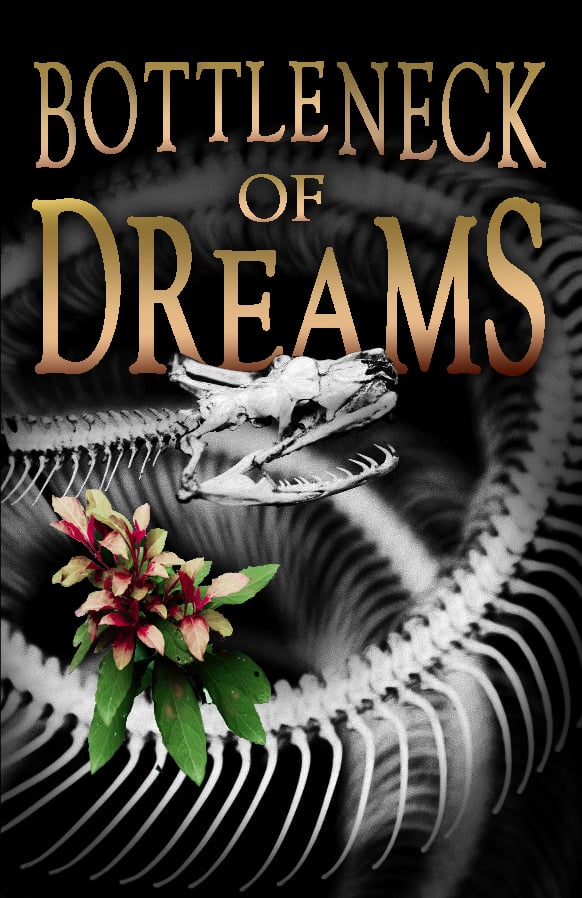
BOTTLENECK OF DREAMS
M. L. Wang
It was dawn when Tresta entered the green, from which no human returned. She had never felt fertile soil beneath her feet. It was springier than she had anticipated, like living flesh beneath a pelt of moss.
The people of the river kingdoms trace their origin back to this moment, when a lone human ventured into the shade to kill a monster. The hero of their myth is King Trestan, who slew the sky serpent. The maiden he rescued from the monster and then married was a sorceress, whose magic raised cities from the sand and brought water back to the desert. Of course, myths change in the telling, reinventing reality over centuries, and that of King Trestan is no exception. In reality, King Drassen was dead long before any human faced the serpent. Queen Tresta was his widow. And her meeting with the serpent was stranger than myth.
Pressing deeper into the shade, Tresta snatched a handful of grass, crammed it in her mouth, and chewed furiously. All she had eaten in the past two days had been the few locusts and lizards she’d caught on the dunes. There was life here, scurrying in the grass, but she didn’t have time to spare stalking or setting traps. So, even though the grass was tough, bitter, and did little to loosen the knot of hunger, Tresta took another handful and chewed. She’d need all the moisture she could get for the climb to come.
Despite the monster’s reputation, Tresta had yet to stumble across any bodies. This was, ironically, among the few places she had ever walked where bones didn’t crunch underfoot. In this moist, dark soil, she supposed bodies could decompose as they had in the old days instead of drying out in tombs of sand.
She tore some particularly succulent leaves from a bush and had them at her lips when a voice spoke.
“I wouldn’t eat those.”
Tresta’s hand flew to her sword, leaves scattering to her feet. Used to scanning for danger through the blistering mirages of the dunes, she struggled to pick out her stalker in the confusion of greenery. All she processed at first were a pair of eyes, peering at her through the tall grass, seemingly disembodied in the shadows.
“They’re not lethal or anything, but they’ll give you a wicked rash.”
As the speaker crept out of hiding, it was clear why Tresta hadn’t noticed them crouched so close to her position. Moss-colored freckles matched the vegetation, and a mess of dark curls melded with the shadows. It occurred to Tresta, as the wildermyn straightened up, that this was perhaps the last place in the world that this strange coloring helped them blend into the environment. Those freckles were a relic from a time when the world had been wet and green. Like all humans now, the wildermyn were a dwindling people, wandering the sands in search of sustenance.
“And you are?”
“Wymgelzan of Ras,” ze said amicably. “I know wildernames are a mouthful for you tall folk. You can call me Wym.”
“Tresta of Berg.” There was no reason to lie. Either the wildermyn was a friend or ze would be dead on her sword momentarily. “I suppose you’re a servant of the serpent?”
“A servant? No.”
“Forgive me if I don’t believe you.” Sazuma killed all intruders to the green except her own minions.
“You’re forgiven.”
“And you’re wasting my time.” Tresta turned to press on. She wasn’t in the habit of showing her back to an enemy, but she couldn’t afford to slow down. And if Wym was foolish enough to try a surprise attack, she was secure in her ability to overcome a diminutive wildermyn.
“Fixing for trouble, are you?” Wym called.
“Sure am.” Tresta didn’t look back. “So you’ll excuse me, but I can’t keep trouble waiting.”
Footsteps swished through the grass, and Wym fell into step beside her. Like most wildermyn, ze was small, barely reaching her elbow. It frankly astounded Tresta that such a delicate people had survived the brutal century since the Ascension. Then again, there were a few months yet before the hundred-year mark. Wym’s people might yet die out before the turn of the century. All humans might.
“Many men have faced Great Sazuma and died.”
“You don’t say.” Tresta didn’t break stride as the grass began to give way to serpentine roots.
“So, what’s so important up there that you’re willing to climb to your death?”
“Princess Biya.”
“You know, that’s just what the men before you said.”
Tresta did know that. She had sent those men, back before the drought had dragged on for three more years, back when men could still be spared on a hope.
“Most don’t make it to the canopy,” the wildermyn clambered after her, annoyingly sure-footed on the uneven roots, which grew thicker with each step. “They fall to their deaths. And those are the lucky ones.”
“Hm,” Tresta grunted and snatched a last handful of grass to chew before the greenery tapered to slivers and finally disappeared between the tree’s roots.
“Not to offend, but you don’t look as well-fed as the ones before you.”
“Good.” She spat out a grass stalk that even her wild-toughened teeth couldn’t grind up. “Assuming the serpent’s not in the mood for gristle and bone, I’ll have a chance.”
“Not if you fall.”
“I won’t fall.” Not because she was braver or stronger than the men before her. Because none of them loved Biya the way she did.
The roots, each the size of a regular full-grown tree, were at the end of their gradual incline. From here on up, it was a vertical climb one thousand feet into the sky. Branches spanned a mile overhead, leaves obscured by the masses of white fluff that cocooned them at all times. Tresta’s mages said the fluff was made of water particles, the same way grains of sand could form deceptively fluffy clouds during a windstorm. It was that moisture, gathering into drops and falling earthward that had allowed an oasis to grow beneath the canopy. The phenomenon—which the mages called rain—had been common across the world before the Ascension. Now, this was the only place.
“Last warning!” Wym called, now well behind Tresta. “This is as far as any human should go!”
“God’s Remnants be with you, Wymgelzan of Ras! I’ll see you on the way down.”
Myth remembers King Trestan as a beast of a man, who scaled the tree with his bare hands. In reality, Tresta had the benefit of bone magic, an art developed much earlier than most scholars assume. Reaching back, she unhooked a sword that had once been the spine of a serpent like Sazuma. Smaller, perhaps, only a few meters long. The razor spines that lined its back could cut through stone and, if the climb went to plan, Tresta hoped they would be strong enough to kill a living member of their species.
Mages had ground the snake’s skull to powder and mixed it with the ink now tattooed into Tresta’s skin. As the sword uncoiled, the tattoos tingled and she felt each vertebra as if it were her own. Her sights locked on a knot twenty-some feet above her head, she slung the sword skyward like a whip, then exhaled, letting the vertebrae spring apart. As the weapon hit its full length, she guided the uppermost spine to the knot, where it drove into the bark and stuck.
After giving the weapon a tug to make sure it would hold, Tresta gripped the handle tight and drew the vertebrae back toward each other. The sword contracted, pulling her with it. In a heartbeat, she had flown fifteen feet upward, where she caught herself with the balls of her feet against the tree. Drawing her ox horn dagger, she stabbed it deep into the trunk before withdrawing the serpent’s spines from the knot above and whipping the sword upward again for a new hold.
A pair of ropes connected both dagger and sword to her belt, so that, even if she slipped, she hopefully wouldn’t lose either weapon or fall to her death. Of course, there were no sure things in the world anymore, but she would rather die trying to get to Biya than face the slow, pitiful end that awaited humanity below. There was nothing left but this, nothing but the climb—sword over dagger, over sword—as, presumably, the sun climbed in the sky at her back. For the first day in her life, Tresta couldn’t see the merciless ball of fire, but it was still present, gradually brightening the cloud canopy as the day progressed. Blessed shade kept Tresta from sweating profusely, but liquid fire started in her shoulders and slowly trickled its way through the rest of her muscles.
At several hundred feet, a bird started circling her, chirping. It was some kind of finch or sparrow—too small to pose any danger to her, but big enough to be a screaming annoyance on top of the pain in her muscles.
“Shoo!” Tresta risked removing a hand from the dagger to swat at the creature, which flitted out of arm’s reach and lit on a protruding knob of bark. It was only then—when the bird held still—that she noticed the moss green speckles across its head and the backs of its wings. It wasn’t a bird at all.
“Wym?” she said, and the finch shrank guiltily, confirming her suspicions. “You’re a wildermage!”
“And you’re more perceptive than you come off,” ze said in a jarringly human voice. “I didn’t realize you were familiar with our magic.”
“My tribe absorbed some wildermyn clans. Useful ones that turn into jackals.” With their ability to track prey by smell, Tresta’s people had made just enough kills to feed everyone through the last year. “Didn’t realize anyone spent a decade training to turn into a shrill ball of feathers.”
“Says the woman scaling a tree with a skeleton.”
“Why are you following me?”
The finch gave a half-flap of its wings that approximated a human shrug. “You’re a stronger climber than I thought. I’m worried you’re going to get where you’re going and die hard. I came to beg you to turn back.”
“Can’t do that.” Tresta wound her spine sword back and swung, mentally pushing the sword’s vertebrae upward as hard as she could to take the onus off her aching arm. The spines stuck and, after the requisite test yank, held.
“Why not?” Wym said as Tresta wrenched her dagger from the bark.
“Biya’s everything to me. She’s all I have left.” Tresta drew the sword’s vertebrae together and welcomed the cool rush over her skin as she shot upward.
“That’s not going to matter,” Wym called before flapping up to her level.
“Enlighten me,” Tresta bit out—not because she particularly enjoyed the chatty finch. The conversation just presented a distraction from the burning in her arms.
“Sazuma belongs to an old race of mages—far older than mine anyway—with the ability to transform into megafauna.”
“So, she’s not a giant snake. Just a woman mad enough to turn into one.” Tresta couldn’t say the technicality made a difference to her. Sazuma was still the monster who had surged through her settlement in the night to steal her daughter. She could still suck sand and die.
“She’s the last living being from before the Ascension,” Wym said, “like this tree you’re hacking up is the last living plant from that time. In those branches, Sazuma guards the last of her people’s magic.”
“Why should I care about any of that?”
“Because she’s also defending the only thing she has left.”
The air had changed, growing heavy with moisture that gathered like sweat on the tree. Tresta’s feet slid on the alien slickness and she bruised her knees but didn’t slow down. Almost there. Sword, over dagger, over sword—and massive branches took shape through the mists above. As Tresta hauled herself higher, each branch looked like a waiting snake and her heart hammered—not with fear but with rage and hunger.
“You don’t have to do this, Tresta of Berg!” Wym flapped anxiously at her ear.
Among the leaves appeared what looked like a human-made platform. Ornate guard rails glimmered with a sheen of condensation.
“Please, turn back.”
“There’s nothing for me back there.” Tresta slung the spine sword one last time.
It whipped upward and caught on a branch just above the platform. This time, when she contracted the weapon, it carried her up over the carved rail. Spines came loose and she tumbled to the slick wood of the platform, exhausted. Wym sighed something that sounded like a curse and flapped off into the fog above.
As Tresta rolled to her hands and knees, the platform was unnaturally smooth beneath her. It was not made from separate rods and planks. Somehow, it had grown seamlessly from the tree, flattening to a walkway before twisting itself into the ornate designs of the guard rail.
“Weird magic,” she muttered and dragged herself to her feet.
Spine sword clutched in her hand, she pressed into the thickening fog. A cluster of vines appeared before her, hanging from the branch above. She pushed her way through the natural curtain and gasped.
Pure majesty spread before her.
The vapor here formed an entire city, with a network of wooden walkways cutting between buildings like roads and swells of manicured leaves penetrating the mist at intervals in place of shrubbery. The cloud architecture was hauntingly familiar, echoing the soaring forms Tresta had only seen in the ruins of pre-Ascension cities like Berg. But where Berg and its neighboring states were crumbled, desolate places, statues fallen, wells filled with sand, no longer habitable, this place was alive with the babble of human voices and running water.
Tresta drew in a breath and found that she was near tears. It was almost like she had stepped through a veil back in time, like the splendor of centuries past lived again. Almost. When she made to touch one of the pillars, her hand went straight through and came back wet.
None of it was real.
A stream wound among the cloud structures, contained in a wooden trough, and women in dresses as airy as the mist glided across the walkways holding baskets woven from vines. The nearest girl dipped a wooden ladle into the stream, lifted a scoop of water, and poured it into her basket. To Tresta’s astonishment, what dropped into the basket was not water but white fluff. All through the white city, women took handfuls of cloud from their baskets and tenderly massaged them into pillars and elegant archways.
This was strange magic. Pre-Ascension magic, long since lost to humanity.
“Mama?” a voice said and Tresta’s heart stopped.
She turned to find a girl in a peach-colored dress standing still in shock. The basket slipped from Biya’s hands, spilling mist like ghosts around her ankles.
“Mama!” And Biya was running, skirts hiked up to keep from tripping, bare feet pounding wetly over the wood. Tresta surged forward to meet her and they fell into an embrace. Now Tresta cried in earnest, her cheek pressed to her daughter’s curls, breathing in the smell, the sheer reality of her.
“I’ve never seen you cry before, Mama,” Biya giggled through her own tears when Tresta took a step back to look at her.
“Either this is a dream,” Tresta said, holding Biya’s face between her hands, “or I’m with my daughter, in a place with running water. Either way, I can spare the tears.” Biya looked more alive than when Tresta had last seen her. Her cheeks had filled out, her hair had grown thicker, and there was more flesh than bone to her body. “You look so beautiful, sweetheart.” She brushed a tear from Biya’s cheek with her thumb. “So healthy.”
“Sazuma takes good care of us here,” Biya said.
Tresta shook her head, confusion clouding happiness.
“I know it sounds strange,” Biya said, “but she isn’t what you think. She… oh.” She smiled past Tresta. “It looks like she’s coming now.”
Tresta turned to find a dark shape winding like the river between the cloud pillars. The voice that spoke was languid and feminine yet somehow massive, like the soft majesty of clouds.
“Wym tells me we have a guest.”
The night Biya had been taken, Tresta had gotten a passing impression of Sazuma’s size—an otherworldly rush of scales that dwarfed the tents of their settlement. Coming to grips with it in daylight was another matter. Sazuma’s glimmering body was as long as a dozen horses and as big around as an elephant’s. Tresta had only ever seen serpent spines in deathly white, on skeletons like the one that comprised her sword. In life, they were blood-red, flexing and shifting as Sazuma moved.
The idea that Tresta’s few-meter-long sword could contend with this creature was suddenly pitiful. But if Tresta couldn’t stand her ground at her most pitiful, she would have been dead a long time ago. As Sazuma approached, Tresta lifted her chin—and noticed a speckled finch perched on one of those red spines.
“You lied to me,” she addressed the wildermyn sourly. “What a surprise.”
“Wym’s job is to turn all comers away at the roots,” Sazuma said in her Heaven-spanning murmur. “Usually, ze’s better at it.” There was a mocking fondness in the way the serpent looked back at Wym, who appeared unafraid.
“Great Sazuma,” Biya said, equally unworried by the appearance of the monster. “This is my mother, Queen Tresta of Berg.”
“Yes, Tresta of Berg,” crooned Sazuma, bringing her head to eye-level with the platform as her coils slung about unseen branches below. “I remember you. You were the only one who told me ‘no’ when I asked for a daughter of your tribe. Even when I asked for an orphan girl, you said ‘no.’”
“And I’m still saying no.” Tresta gripped Biya’s arm. “I’m taking my daughter home.”
“I would rather not part with her,” Sazuma said.
“Fine by me,” Tresta bared her teeth. “I’ll make her a sword from your bones.”
“Mama, don’t!” Biya grabbed Tresta’s arm before she could uncurl her weapon. Of course, no one could stop Tresta if she really wanted to attack; it was her mind, not her arm that moved the spines. The touch was a request. “Please don’t.”
“Why not?” Tresta snarled, the segments of her sword shifting with the itch to fight.
“What is this?” The serpent’s eyes fixed on Tresta’s weapon. Her voice dropped to a dangerous hiss that shook the leaves. “Explain yourself.”
“I didn’t kill one of yours to make it.”
The serpent hissed lower but didn’t strike. Of course, she knew it was the truth. Tresta wasn’t old enough to have co-existed with others of Sazuma’s race.
“You are a thief!”
“I’m a thief?” Tresta’s voice rose in rage. “You stole my child! My warriors! The future of my people!”
The serpent didn’t attack or raise her voice. She simply drew back, golden eyes narrowed as if in thought. When she spoke again, her voice was soft with sorrow Tresta wasn’t ready to hear. “Where did it come from?”
“From a skeleton. That’s all we have left on the ground, you know. Bones.”
“There is no excuse to desecrate a body.”
“But you have an excuse to steal the living away from their families?”
“As you see.”
“See what?” Tresta snapped.
“All of this, Mama,” Biya piped up earnestly. “Sazuma maintains the tree and keeps the water from flowing away.”
“She what?” Tresta might have struck at Sazuma right there, with her bare fists, if Biya hadn’t been standing between them.
“The water comes from a great spring at the center of the tree,” Sazuma explained primly—damn it if Tresta understood how a tower-sized serpent could sound prim, but she did. “My magic contains it within the trunk and brings it here to the branches.”
Tresta had to smother her fury to keep from screaming. “You mean to tell me that there’s a spring here that could feed rivers on the ground, and you’re just taking it? Why?”
“To create this.” Sazuma turned her great head to the cloud city, spines flared with pride. “Civilization! And the sky as it was before the Ascension. Girls take to cloud magic better than boys. That’s why I ask for daughters.”
“Or just take them,” Tresta said darkly.
“I need them,” Sazuma said with an infuriating air of self-righteousness. “They help me build the sky and the men who follow them here help me guard it.”
“Surely, before the Ascension, clouds formed on their own, not just when chieftains offered up their children?”
“Before the Ascension, the sky didn’t need building. God was here to do it for us.”
“And is that what you are now?” Tresta said. “Our new god?”
“Call me what you will.” Sazuma drew herself up tall over the platform, an imperious tilt to her head. “I’m the only thing maintaining the sky as it should be.”
“As it should be? Who are you to say this is the way things should be?”
“You have no memory of what the world was like before. I do.”
“Is that supposed to justify anything? You’ve stolen our water and our children and for what? To serve your senseless nostalgia?”
“It’s not senseless, Mama. We’re holding the sky in place.” Biya spoke with pride that made Tresta want to slap her.
“Your brothers are dead. Did you know that?” Tresta may as well have slapped her for the shock in her eyes.
“No…”
“They both took ill during the drought and didn’t have the strength to recover. Oh, and that boy you were so fond of—Yaren? Dismembered by hyenas while scouting for food. But by all means, yes, the sky must be held in place!”
Biya’s hands were over her mouth. She fled, muffling sobs.
“Queen Tresta…” The empathy in Sazuma’s voice—as soft as her cloud kingdom and clearly as fake—was more than Tresta could stomach. “That was unkind.”
“The world is unkind! While you sit up here playing pretend, the rest of us have to live in it!”
“Are your people really dying in such numbers?” Sazuma asked, again in that insultingly tender voice.
“You’ve been to our settlement,” Tresta spat as nervous women—and a few men—gathered on the nearby walkways to watch the argument. “You know what our numbers are like.”
“I assumed that wasn’t your entire population,” Sazuma seemed confused. “Berg was once a city-state of several thousand.”
“Before the Ascension, sure. By the time I was born, there weren’t a hundred of us.”
And that was after the remaining people of Berg had joined with other struggling tribes who had once belonged to rival city-states. When Tresta came to power, she had even convinced her people to join ranks with the wildermyn and nomadic herders who had once been their mortal enemies. None of those old rivalries mattered in a world with no cattle, no horses, no cities, and ever fewer cultural markers to distinguish one starving husk from another.
“And how many are you now?”
“Forty-four.” Probably fewer since Tresta had left them. “Obviously, that doesn’t matter to you. So, why don’t you just eat me and make it forty-three.”
Sazuma recoiled, spines quivering in revulsion. “I do not eat people.”
“Then those stories about travelers being devoured as soon as they enter your oasis?”
“Credit to Wym for zir graphic imagination. Mine are a peaceful people, practitioners of gentle arts and magics. I’ve never harmed a living creature.”
“Really?” Tresta barked a savagely incredulous laugh. “What about the people below who need the water you’re hoarding up here? I suppose they’re not harmed?”
“I’m not…” Sazuma’s coils shifted in discomfort. “I prefer not to think of it that way.”
“I could give a damn how you prefer to think of it! Thousands of people could be alive right now if not for your little art project! If you think you’re not responsible for that, you’re a delusional child!”
Silence. The cloud kingdom had stilled, holding its breath.
“Excuse me, Tresta of Berg,” the serpent said without emotion, “I must return to my spring.”
“Your spring—?” Tresta started forward, but several men had drawn close, uneasy hands on their weapons. A few, infuriatingly, Tresta recognized as her own. They were ready to fight her for this snake, this monster—
“This woman is our guest,” Sazuma said as she melted into the mist. “Treat her as such.”
When the serpent was gone, Tresta grudgingly allowed two of the girls to take her to a pool where she could bathe. Sazuma’s cloud architects had contrived a structure that looked like a pre-Ascension bathhouse, though, of course, Tresta and the girls accompanying her walked straight through the front steps into the interior. Tresta had never had a bath before. The most water she had ever seen was a muddy pool that came up to her shins, and that had been some thirty years ago.
When she had scrubbed the grime from her skin, the girls gave her a dress of airy fabric like their own. The garment was so much lighter than Tresta’s animal skins that donning a weapons belt over it felt like fastening the leather over her naked hips. As she slung her sword across her back, she became conscious of feet in the fog behind her.
Biya was not particularly stealthy. Never one for the hunting party, that girl. Always a gatherer.
“She’s like you, you know.”
“Who, Sazuma?” Tresta rolled her aching shoulders, the usually dry crunch of joints softened by the humidity. “I thought an abundance of water was supposed to make you healthy. Didn’t know it made you stupid.”
“She’s a stubborn mule who can’t let go of anything,” Biya said, and Tresta hid a smile. Better that her daughter bite back than run off crying. A girl needed bite to survive. “When the world falls apart, she holds it together. Like you did, all those years you drove us on through the wilds to look for more food when everyone wanted to give up. Like when you pushed for an alliance with the herdsmen. Like when you wouldn’t give me up to Sazuma. The world can literally come to an end and you won’t give up on your dream of something better. She’s the same.”
Tresta couldn’t decide if life here had made Biya wiser or more naïve. Maybe a bit of both, if that was possible. When she reached back to rebraid her hair, Biya’s fingers were there, doing it for her.
“You should try talking to her again.” Biya gathered her mother’s tresses into a plait on years-old muscle memory. “She retreats to the upper branches when she’s upset, but you can climb.”
Tresta didn’t want to speak to Sazuma again. Truthfully, she still wanted to kill her. But she needed the snake if she was going to get her people home. Trying to take the non-climbers down the trunk with only a few vines and bones seemed unwise.
Tresta spent the next day catching up with Biya and her men, seeing the cloud city, exchanging stories and mourning lost loved ones. She had thought that the serpent might reappear at some point, but she never did, and as dusk fell, Tresta made the climb to the top of the canopy.
She found the serpent draped over some branches at the cloud line. In the moonlight, Tresta was upset to find that Sazuma was beautiful, black scales iridescent in the whiteness—like pools of mirage among the dunes.
“Tresta of Berg,” Sazuma murmured as Tresta climbed onto the platform nearest to her head. “You’re looking well.”
I’m looking ridiculous, Tresta was tempted to snap. She might be cleaner than before, but a dress of dreams would never suit a creature of callouses and sinew. One might as well put a gown on a hyena. But she bit down on her hostility, reminding herself that she was here not to slay a monster but to practice diplomacy. One queen to another.
“Great Sazuma,” she said as respectfully as she could, “I shouldn’t have shouted at you yesterday. I’m sorry.”
Sazuma made a deep sound that wasn’t quite acceptance. “No one has spoken to me that way for a long time.”
“The people you kidnap don’t yell at you?”
“Usually, their first experience of me is the inside of my mouth. I think it makes them less inclined to tell me off.” Tresta couldn’t tell if the serpent was joking until those golden eyes turned to her with a tint of mirth. “Of course, they yell. But most calm down as soon as I show them this life of magic and plenty. No one’s called me a delusional child.”
“I just came to say… you should take this back.” Tresta unslung her spine sword and placed it on the platform before her. It was the only peace offering she could think of. “Lay it to rest or… whatever you need to do. It belongs to you…” Tresta took a breath, “but Biya belongs to me. Please, Great Sazuma, I need my daughter back.”
“Does she want to go?”
“She’s the heir to Berg.” Whatever was left of it. “The future of our people. You can’t just feed on that future to restore the past.”
“Why not?” Sazuma said, petulant. “The past was greater.”
“Of course, the past was greater!” Tresta said in exasperation. “It always will be if you do everything you can to smother the future!” In the absence of her sword, her hand had gone to her dagger. Tresta, you idiot. “Sorry.” Stiffly, she opened her fingers and took her hand from the dagger. Despite her rage, she couldn’t kill someone Biya had come to love. “Sorry. I’ll go.”
One of Sazuma’s coils moved in Tresta’s way. “That’s not necessary.”
“What?” Tresta turned back. “Going to eat me after all?”
“I told you, I don’t eat people. I don’t eat flesh at all.”
“You’re a snake,” Tresta said before remembering that that wasn’t technically true. “Or… Wym said you were some kind of ancient mage.”
“That’s rude, Tresta of Berg. A hundred and five isn’t even middle-aged for my people. Hardly ancient.”
A hundred and five? Tresta wasn’t sure what surprised her more: that Sazuma had a sense of humor or that she had been only six years old at the time of the Ascension.
“Do you not take human form at nightfall? Or daybreak?” Tresta had heard that transformation worked differently for different wildermyn.
“Magic on this scale—the raising of rivers and trees—only works in the form of a great animal. And a mage can only transform into extant animals.”
“Oh,” Tresta said very quietly.
The Ascension had wiped out every creature bigger than a horse—the elephants of the scrublands, the oxen of the marshes, and of course, the titanic snakes of the jungles further south. If Sazuma reassumed her human form, she would never be able to turn into a serpent again. The last megafauna would finally be extinct.
“So, you haven’t taken human form since the Ascension… since you were a child?” God’s Remnants, Sazuma had never even lived in her adult body. “Doesn’t holding this form shorten your life?”
Sazuma didn’t respond except for a slow sliding of her coils on the surrounding branches. The tip of her tail touched the spine sword and pushed it back toward Tresta.
“Keep it.”
“But—I thought—”
“I can’t put this one to rest. They’re bound to you now.” There was something more than sadness or resignation in Sazuma’s voice. There was envy. “Their place is in the future, with you.”
Wordlessly, Tresta took the sword.
“And take your daughter.” Sazuma’s voice was so quiet amid the rustle of the leaves that Tresta looked up in shock, unsure she had heard right. “I have been a child,” Sazuma said with such pain that the mother in Tresta didn’t want to blame her. How could she be anything other than a child when she had grown up without guidance from adults of her own kind? “In my mind, I wasn’t really taking anything. The people here seemed happy in the world I made them, so… It didn’t occur to me that wrapping myself in the past would come at the expense of someone’s future. Biya and all the others should go back with you.”
Tresta could only stare as a breeze stirred the mist between them. Because those weren’t the words of a child. They were the words of a woman whose heart was big enough to encompass more than her own dreams. If Sazuma meant them, those were the words of a leader.
“I’ll stay here as long as I can,” said Sazuma, “until…” Until she died. Along with her magic, her serpent form, and all memory of the world before the Ascension.
“Sazuma…”
“What?” the serpent turned wearily to Tresta. “Isn’t that what you want?”
It was. At least, it had been until that moment. In the glimmer of longing in Sazuma’s eyes, Tresta had glimpsed a future, a hope for them all. Like all hopes, this one had the slippery quality of a mirage, but Tresta knew with a hunter’s certainty that she was on the trail of something real.
“I know the climb isn’t safe,” Sazuma said. “I’ll carry you all to the base of the tree.”
“Maybe…” Tresta started, unsure of where she wanted the sentence to go, sure only that she had to follow the channel of thought toward that solidifying mirage. “Maybe you could take us further.”
“I dislike venturing far from my tree.”
“No—listen, Sazuma.” Tresta’s thoughts were racing now, tumbling inexorably earthward with the sheer inevitability of gravity—like much-needed water. “All you have up here is the memory of a world that used to be full of life, and all we have below are the bones of that world. Neither of us is really living.”
“How can we?” Sazuma’s voice was so broken that Tresta inadvertently reached forward, as if falling, and put a hand to one of her coils.
“Together.” There was human warmth trapped somewhere beneath those scales. And Tresta’s mirage took form. Water rushed home. “Come live with us.”
Sazuma turned to her in shock. “What?”
“If you stay here, you’ll die alone.”
“If I leave, the sky will fall!”
Tresta had never known a being could sound so frightened. “But this isn’t the sky, Sazuma. It’s just a memory, just vapor and dreams. What are you really holding onto up here?”
“My world, Tresta! My family!”
“But you have a family.” Tresta had come to understand that much just talking to Biya, Wym, and the others, “One that you’ve built by your own power from nothing. These men who are loyal to you, these women who’ve come to understand your magic. All of them have a home out there on the ground. You could share that home with them. With your power, you could make it a home worth living in.”
“Could I?” Sazuma whispered. “Or am I just vapor and dreams?”
“I…” Tresta was not in the habit of lying. “I don’t know. But I do know that you’re something we haven’t had on the ground in my lifetime. You’re—” Pride tried to stop the word on its way out of her mouth, but strange gravity set it free—“beautiful.”
Sazuma’s coils shifted abruptly, the spines near her head fluttering in surprise. “Pardon?”
“You win, alright?” Tresta gestured around her too emphatically in her annoyance. “This place is incredible, damn you. I want to be angry at Biya and everyone else for being seduced by it, but I can’t. I…” She was halfway to admitting there had been tears in her eyes when she first beheld Sazuma’s city but decided she needn’t stoop quite so low. “Your vision is more beautiful than anything I’ve ever known. If you stay here, all that beauty dies with you. Your peoples’ legacy dies with you.”
“It will die with me either way,” Sazuma said in unspeakable grief. “There are no more of my kind, and I won’t be able to have children after holding this form for so long.”
“That’s not the kind of legacy I’m talking about,” Tresta said. “Pushing out offspring is no legacy if you leave them no future to inhabit. But, with your power, there could be a future, new generations who remember your art and tell your stories. Come down with us. Let your knowledge have a life after you’re gone.”
Sazuma seemed to consider for a moment. Then her spines shivered and she turned away. “I’ll take you and the others down the tree in the morning. You have what you came for. Now leave me be.”
“No.”
Snakes didn’t sigh, but Sazuma managed a sound of deep weariness. “What?”
“Everyone goes home tomorrow… Except me.”
“What are you saying?”
“I’m going to wait here with you, as long as you need. Until you’re ready to come down with me.”
“What if it’s a while?”
“Then I’ll wait a while.”
In the myth, King Trestan battled the serpent for a hundred days and a hundred nights, during which time, his strength won the heart of the maiden, Sazuma. In reality, the battle was of hope against despair, the vision of a future struggling for clarity against the crushing prospect of extinction. Tresta and Sazuma fed that glimmer of hope, discussing resources, magic, and other practicalities until it was no longer a mirage but a plan.
“I’ll need to oversee almost all of these projects myself,” Sazuma fretted when their final design spread before them, in runes and wood models in the mist.
“Mm,” Tresta hummed in thought, then smiled. “You’ll just have to marry me.”
“What?”
“I’m good at finding food and forging alliances. I wasn’t brought up on this…” Tresta gestured vaguely at their plans, “logistical nightmare of roads and channels. If you’re going to take charge of that part, you may as well do it as the queen—a queen. One of two.”
Sazuma’s spines had flushed an unusually rich shade of red. “I didn’t think women of Berg took wives.”
Tresta shrugged to cover her own nervousness. “Berg was gone before I was born. This is something new and in this new something… I’d like to be your wife.”
Sazuma still seemed stunned by the offer. “You wouldn’t rather have more children?”
“We have an heir in Biya. And I’ve filled my poor husband’s role so long, I hardly need a man to fight and hunt for me. I’d rather have someone to soften my rough edges, to teach my daughter what I can’t. So, Great Sazuma, if you’ll have me—”
“Yes.” It was in that breath that the mist of Sazuma’s canopy began to disperse, that vapor gave way real hope. After three months, it was not brute strength that felled the serpent and won the maiden’s heart. It was the promise of a family that might outlive her. “Yes, Tresta. I will have you.”
So it was that one hundred years to the day after the Ascension, Great Sazuma descended.
For all the details lost to legend, this day is remembered accurately as a day of thunder, followed by flood. When the serpent released the spring, it was too much for the parched earth to absorb and water swept the land for hundreds of miles. Sazuma bore Queen Tresta and what remained of humanity upon her back as the floodwaters rose, saving them from drowning.
Then, as the waters receded, so did Sazuma, thinning, shrinking. Legends say that, as the water settled into channels, the dying serpent lay down and became the greatest of these rivers. In reality, Sazuma’s end was not so mighty. Nor did it come that day. In reality, Tresta walked the water’s edge until she found a form huddled in the dark, spent and small.
“Sazuma?”
The sound of her name gave Sazuma the strength to move. From that shivering knot uncoiled not a snake, but a limbed creature, a human. She wasn’t a little human, like Wym, but a full-grown, full-figured woman nearly Tresta’s size, clawing helplessly at the soil with limbs she had forgotten how to use. After all, the last time she had taken this form, she had been no bigger than Wym, unburdened by an adult’s hips, breasts, or shame.
“I’m weak,” she whimpered, barely able to hold herself up with both palms flush to the soil.
“Well, you’re new.”
“Am I…” Sazuma’s voice shook. “Am I beautiful?”
Tresta couldn’t help a laugh. “Well, you’re certainly as vain as ever. But, yes.” Kneeling, she pressed a kiss to Sazuma’s shoulder. “Yes…” And she placed a slow progression of kisses across Sazuma’s body.
Shuddering, Sazuma came back into being under Tresta’s lips, one piece at a time, until she was a whole woman beneath the stars. The wholeness, in her smallness, was unbearable. Her eyes, wide and human, without a trace of their former gold, beheld the naked sky in terror.
“Where is my world?”
“It’s right here, Sazuma.” On land that would finally yield crops, that would finally be a home for more than bones. “It’s whatever we make of it.”
With no cloak of clouds, scales, or artifice, Sazuma curled into Tresta’s arms to keep from disintegrating.
“Biya and the others are worried to death about you, love. Are you ready to come home?”
This time, it was Sazuma who kissed Tresta, softly as she did everything. “Yes.”
So, as the serpent had carried humanity over the floodwaters, Tresta carried her bride over dry land to the new home of humanity.
In reality, Sazuma died a hundred years after the flood, amid the flowers of the queendom she had founded with her wife. In reality, the serpent slayer, King Trestan, was neither a king nor a serpent slayer. The king was a queen and the maiden was the serpent. But in the way of humans, Tresta’s descendants built the myths that made them comfortable. Carefully curated handfuls of cloud. Memory on memory. Vapor and dreams.
I hope you enjoyed Bottleneck of Dreams! This story is a companion prequel story to my upcoming Altima universe. You can find my published books on Amazon.
Winner of Mark Lawrence's Self-published Fantasy Blog-off 2019
"Fantasy and martial arts aficionados alike should enjoy this emotionally supercharged novel about love and loss, which pierces readers' hearts with the precision of a samurai's razor-sharp blade."
- Blue Ink ★ Starred Review
