M. L. Wang
Seven Forsaken
Please note that the chapter below is an early draft. Names and world-building details subject to change. Also, as of this chapter, this particular serial is on hiatus. I will pick it back up as soon as my writing schedule allows.
Chapter 13 - Jewel of the Jungle
The canoes arrived not long after Miorei. The slight vessels were packed with men of Lothmedi, bearing paddles and spears.
“Why all the weapons?” Ro’aan asked suspiciously—as though he had any room to talk.
“The weapons are not for you,” Miorei said as the Lothmedians skillfully pulled their canoes alongside the Waning Ibis. “This is the jungle.”
Spoken, with inflection, the Wilder-adjacent language was easier to understand. However, Isa still wasn’t sure what ‘this is the jungle’ meant until he noted some of the men with spears disembarking. Paddling upriver had clearly required four strong men to a canoe. Traveling downriver would only require two to a boat, and they had to make room for their passengers.
“These men are walking back,” Isa observed. That was the reason for the spears, shields, and wooden slat armor. “Are they worried about the monster?”
“The monster?” Miorei said. “No, no. That creature lives much deeper in the jungle. Here, the largest predators are jaguars and tigers.”
“Oh.” It was hard to imagine a green deeper than the thicket around them now. Though dense with muscle, the men of Lothmedi were not taller than Miorei. They all shared her leopard-spot-like godmarks in varying shades of brown and green. For their sake, Isa hoped they had the same uncanny strength as the Wildermyn upriver.
“What is that stuff?” Ro’aan wrinkled his nose as he watched the armed men of Lothmedi rub a brown paste onto each other’s bodies.
“The dimwit asks what the brown substance is for,” Lygdaz translated to Miorei—somewhat hypocritically, Isa thought—since ze was clearly as curious as the dimwit.
“Protection,” Miorei said.
“Protection from what?”
“The little killers. Flesh-eating ants, hornets, leeches, and poison frogs. If you had attempted the remaining walk to Lothmedi—if you had even left your ship to look around—I would be speaking to your stripped bones.”
The Ibis’s crew had thinned over the past weeks, but it was still remarkably close to a full rowing team. They had to pack three passengers into each canoe along with the two Lothmedi paddlers. Isa ended up squashed in with Ro’aan and Miorei. He attempted to brace himself away from her to maintain a respectful distance, but she didn’t seem to mind.
“I will transform if you are uncomfortable.”
“No worries,” Isa said. “I’m alright.”
“Have you heard any word from my friend, Queen’s Tongue?” Damored asked as her canoe pulled close. “Corrath?” The word she was looking for was probably ‘associate’—Isa didn’t think there was a soul on Earth with the nerve to call Corrath’ friend’—but her Wilder dialect was too clunky to accommodate such nuances.
“The osseomancer and his small companion arrived two days ago,” Miorei said, fondly scratching Sweet Mango’s neck feathers.
“Wait. Small companion?” Lygdaz said uneasily. “Who—”
“Two days ago?” Damo cut in. “But I left first! On a fast horse. How did he leave and come back before me?”
“Maybe he didn’t detour so long having sex in Krell,” Isa suggested.
“You’re still mad at me about that?”
“No,” Isa decided. “Just…” Just wondering how he was supposed to catch up to Nazaru and reclaim the Herpendium now. Maybe it was good that Isa’s party seemed to be so far behind. Maybe the monster would do the hard part and spare Isa his role in the kill circle.
“What about the other boat, Queen’s Tongue?” he asked Miorei.
Her strange, large eyes blinked at him in confusion. “Other boat? You mean Corrath’s?”
“No. There was an Inkarnam like me. Well, not quite like me. Skinnier and unnaturally fair in complexion. He was traveling with a strange-looking foreigner.”
“Snake Spirit, you are all strange-looking foreigners here.”
“Right,” Isa said, “but you must remember these ones.”
Miorei shook her head. “If such people came down this part of the river, they never stopped in our city. As you can see, northern ships never make it.”
Following her gesture, Isa’s eyes fell on an eerie sight. The overgrown skeleton of a galley. Large vines had caught the mast and prow much like they had caught the Ibis not far upriver. Over time, a comprehensive snare of smaller vines had swarmed the deteriorating ship, freezing it forever in the moment of its doom.
“Maybe they didn’t take a boat all the way,” Isa suggested as the canoes slipped around the rotting galley like a shoal of fish around a hippo carcass. “Could they have continued on foot?”
“Without a guide?” Miorei said in amusement. “Unlikely. Any foreigners our scouts find on this land are immediately brought before the royal family. And if our scouts don’t find them, well… often they find their bones later.”
Alright, maybe the jungle itself had already done the hard part for Isa. He frowned, conflicted at the thought of Nazaru being consumed by flesh-hungry insects. Before he could decide precisely how he felt, the canoe bumped down a short drop. Isa pitched forward, nearly falling on top of Miorei before catching himself with both hands on the frame of the canoe.
“Osu—Sorry!”
“It’s alright, snake spirit. Let me put you out of your misery before the rapids.”
With an animantic bang, she transformed. Emerald wings beat the air by Isa’s head, and a pair of talons gripped his shoulder.
“Rapids?”
“Not for a ways yet,” Miorei’s words came out in scratchy bird’s voice, retaining her inflection. “Relax.”
Idly, Miorei preened, sliding her beak down a long tail feather until it snapped back into place crisper than before.
“Are all Lothmedians animancers?” Isa asked as he watched her fuss over her feathers.
“No. Only a very few with a royal license to practice. I belong to a caste of parrot-shifters that has served the royal family for four generations.”
“Can all Lothmedi animancers talk?”
“Spirits, no!” Miorei let out a birdish chuckle. “Messenger parrots are spectacular mimics of many sounds, including human voices. Poor Sweet Mango’s vocabulary is limited, but that’s why I always send him to greet foreigners. Hard to give up state secrets with a vocabulary of “good boy,” “pretty bird,” and “want a treat.” Now, careful, snake spirit. The rapids approach.”
“It doesn’t look rough ahead,” Isa observed.
“It will be rough around the bend.”
“The bend?” Isa squinted ahead as the canoes sped on and saw that the river indeed forked like a serpent’s tongue ahead. One branch carried on smoothly—presumably toward the coast beyond the jungle—while the other narrowed and churned. There were no rapids like these in Azenkar, and Isa gripped the sides of the canoe tight in reflex.
“Don’t clamp up so,” Miorei said. “The boatmen will hold you upright. Keep your bottom settled and lean against the tilt.”
“The river doesn’t naturally fork like that, does it?” Certainly, no such forks existed in the Riverlands.
“No, indeed. Our ancestors dug this channel to feed the lake.”
“A man-made lake in the middle of the jungle?” Isa said, impressed.
“Of course, there’s a lake, snake spirit. How else would we farm?”
“Farm?” Isa repeated, uncomprehending. What on Osu’s Earth did a lake have to do with farming? The season in Azenkar brought the water levels up and down, allowing for a varied rotation of crops along the banks, but how could the limited shoreline of a lake provide the same way? Especially when the natural growth all around was so dense and overpowering? “I don’t understand.”
“Most foreigners don’t until they see it,” Miorei and said and took to the air before the rapids turned Isa’s shoulder to an unsteady perch. The canoe should have capsized several times over by Isa’s estimation, but the skillful Lothmedi boatmen rode the rapids like tamers astride wild horses, keeping them all upright.
“You see why I told you northfolk to leave your vessel,” Miorei chuckled as she and Sweet Mango flapped easily above the canoes.
The “northfolk” were all too busy holding on to answer.
As the school of vessels plunged down another drop, the trees ahead parted on a blinding sight. At first, it seemed that a strange god had gathered all the winking stars in the sky into a pile. It took Isa a moment to realize he was looking at the shimmer of sun on open water. A lake.
“Here we are!” Miorei fluttered down to perch on the canoe’s bow as it slid from the rapids onto the shining smoothness. The cloying green gave way to blazing sun. “Welcome to Lothmedi, jewel of the jungle!”
As Isa’s eyes adjusted to the light, he realized that the lake was far bigger than the strip he had first glimpsed through the trees… bigger than any body of water he had ever seen. Ahead, tiny islands slotted together on the surface like python markings. Although were they islands? Some of them seemed to be in motion, gently shifting with the water like spots on the slithering snake.
“This is how our people farm.” Miorei snapped back to a woman. “Beautiful, no?” She smiled as the animantic echo shivered across the lake’s surface.
The patchwork of islands covered a vast disk at the lake’s center before converging on a cluster of stone structures. Rising over all the foreign architecture was an edifice to rival any great church in the Riverlands, birds swirling about its five towers. The palace. Isa imagined that if he climbed to the canopy of the surrounding jungle, those towers would be the only sign of Lothmedi protruding from the green.
“Goddess!” Ro’aan gaped in open awe. “This city is massive! I mean… how many people live here?”
“What does he ask?” Miorei said.
“The population,” Isa said.
“We are two hundred thousand,” Miorei said, “as of last year’s census.”
“What’s a census?” Ro’aan asked when Isa had translated.
“A thing done in civilized states. Not something you’d have in the Barrowlands, I suppose.”
The Zarkadian glowered, but Isa was more curious about Lothmedi than he was invested in insulting Ro’aan. “So, this is a proper city-state.” He turned to Miorei in awe. A population a quarter the size of Krell’s, thriving here in the least hospitable of lands. “And it’s all sustained by a lake?”
“A carefully cultivated lake,” Miorei said.
At this distance, it appeared that each island cluster had a family to work it, tending rows of plants with their children, bare feet clinging to the uneven vine lattices. Some farmers paddled canoes laden with more colorful fruits than Isa had seen at the richest market in the Riverlands.
“Do they use tactomancy?” Nath asked Damored from the next canoe. “Is that how they grow these things on top of the water?”
“No,” Damo said, “no tactomancy.”
“Then how?”
“Honestly, I’ve no idea. I’m no farmer, but when I asked on my last visit, no one here knew a thing of tactomancy. My abilities are quite the oddity to them, and the idea of such magic bein’ used on plants is odder still.”
“So, this was all achieved through old-fashioned, non-magical agriculture?” Nath marveled. “Do you believe that, Danger Noodle? You’ve worked in agriculture.”
“I don’t mind saying I was a terrible farmer,” Isa said, “and even if I weren’t, I recognize precisely none of these crops. I’m not the person to ask.”
Fish of brilliant colors swirled beneath their canoes and flashed among the roots that trailed down from the floating farms. Lake Lothmedi was shallow, Isa realized, and the islands were rooted like lily pads to the bottom. That was why they shifted with the water but didn’t drift enough to collide with one another. As the canoes wove in close between the flowering islands, many of the tending farmers stopped to gape.
“Hello, there,” Isa said to a child of undetermined gender. The skinny thing started and nearly slipped into the water before scrambling back up through the vines to hide behind zir mother’s shift.
“Don’t mind the commoners, snake spirit,” Miorei said with a dismissive air. “They are of no consequence.”
“I am a commoner, Queen’s Tongue.”
“A commoner an animancer!” Miorei exclaimed. “My, you practice strange customs in the north!”
“It’s not a matter of custom as much as strange circumstances. I belonged to a cult before I…” Isa lost his grip on his poor Southern Wilder dialect as he took in more of the families standing on the man-made islands.
“What is it?” Miorei asked.
“All the children here are zermaii.”
“Are what?” Ro’aan asked, and Isa realized that despite his fluency in Hunter’s Pidgin, not everyone knew the Wilder word zerma.
“Genderless,” Isa specified. “The adults are all men or women, dressed accordingly.” The women tied their long hair into two tails over the shoulders while the men wore only one down the back. The differences in the peasants’ clothing were subtler but ultimately moot since both men and women worked bare-chested. “The children are all covered… and their hair is the same.” Cropped short about the ears, signaling no gender. “They present neither male nor female. Like Lygdaz.”
“Wait, Lygdaz is a man, though, right?” Ro’aan said. “I can never tell with the Wilderfolks.”
“You’re not supposed to be able to tell,” Isa said impatiently. That was the idea behind their formless smocks and cloaks. “If ze is male, it’s not something you should say to zir face—or mine, for that matter,” he added, feeling something of Elder Thrask in his admonishing tone. “It’s incredibly rude.”
“He—ze—didn’t seem to mind it while we were tracking Nath Vendan.”
“I guess, if Lygdaz works for hire in the Riverlands, ze can’t be too sensitive about it, but ze isn’t exactly a normal Wildermyn.”
“Oh…” Ro’aan stared into the bottom of the canoe as a thought seemed to dawn on him. “That’s why Akkila hated me! I called her she.”
“That’d do it,” Isa said. Or maybe the Strandwraith just hadn’t been fond of slow-witted Zarkadians. Not for the first time, Isa wished he’d fed this fool to the crocodiles instead of the wise and fearsome hyena-shifter.
“In Lothmedi, no adult is zerma,” Miorei said. “A child chooses zir gender when ze comes of age.”
“Chooses?” Isa said. “Just… whichever they want?”
“Or whichever best suits the family and community.”
“So, you’re all corporomancers?”
“All our priests are,” Miorei said. “When a child comes of age, they will cut out what isn’t needed and grow what is.”
“What is she saying?” Ro’aan asked. When Isa translated, he looked like he might be ill. “They what? That’s impossible! Unnatural!”
“It’s neither impossible nor unnatural,” Isa said.
“What do you mean?”
“You know, it’s done all the time in the Wilds. We just don’t see it because, well…” Because no Wildermyn displayed their gender to the public. “A lot of Riverlanders go into the Wilds to be changed too, but they don’t talk about it when they return.”
“So… you’re telling me that I could have encountered some of these people in Krell, in Azenkar?”
“Probably. One of my Temple siblings came into Osu’s—into the world—with an ill-suited body. When we came of age, she went into the Wilds to have it changed.”
“What a beastly thing!”
“It’s not a beastly thing,” Isa said. “It’s a thing of Truth and the soul.”
“But that’s not—The soul is born into a body,” Ro’aan protested. “A proper, goddess-given body.”
“To us Inkarnam, bodies are of Osu, Spirit of the Material. And all material things are subordinate to Aer, Keeper of Souls. Aer knew Kendiri was a woman, so she compelled Osu to agree. The only Truth that matters is in the Soul.”
“That’s not what she said, though, is it?” Ro’aan said with a dark look at Miorei. “She said they choose based on what the community needs. It sounds to me like state-enforced mutilation.”
Isa supposed, grudgingly, that Ro’aan had a point. He’d never heard of anyone forcing a corporomantic change in the Riverlands or South Wilds. Clearly, things worked differently here.
“Did you undergo this ritual then?” he asked Miorei in curiosity. “Did these men?” He gestured to the rowers.
“Of course. “We all undergo the ritual between the ages of fourteen and eighteen. A month sequestered in the Temple. What they changed—or don’t—is not for anyone to know. All that matters is what we are when we come out.”
“So, the choice to be a woman… was that something you wanted?”
“Oh, yes,” she said, seemingly unbothered by what felt like Isa to a deeply personal question. “My family’s animancy and the mantle of Queen’s Tongue passes through the female line, so the decision was easy.”
“I see.” So, Ro’aan wasn’t entirely wrong. Miorei’s decision, at least, seemed to have little to do with her soul or self-concept. It had been a political decision. As Isa mulled the implications of such a system, Ro’aan still looked utterly disgusted.
“Letting state corporomancers touch anyone,” he muttered, “let alone children!”
“Don’t you have corporomancers in Zarkae?” Isa asked.
“That we do. Unfortunately.”
Over time, the islands grew bigger, then gave way to stone structures that would almost have been at home in Azenkar. Almost. There was something alien about their construction—more angular than arched, cut into rectangles that played with Isa’s depth perception. These were clearly the homes of Lothmedi’s upper class. Men and women in rich fabrics moved along straight stone bridges and lounged on balconies.
At a distance, Isa might have thought that the fine structures were poorly kept. Up close, he could see that the moss and plants gathered on the walls and rooftops didn’t represent wild, random growth. A servant picked her way across one of the rooftops, carefully pruning the growth with a knife and plucking weeds from between the desired plants.
The palace itself towered over all the development, ornate towers jutting into the cerulean sky. The base stone that touched the water was different and seemed to be much older. Was it stone at all or a clay-like compound that had been packed or poured into shape? In places, the foundation cracked open to expose what looked like steel bones. What sort of architecture was this? And how long had it sat here in the lake? Perhaps the steel-skeleton stone predated the lake and Lothmedi itself. Peering over the side of the canoe into the clear water, he saw that the rough alien walls plunged far down before vanishing into the dark of this deepest part of the lake.
“The rest of your team have been awaiting you,” Miorei said as they neared the palace. “You’ll be quartered with them until the queen is ready to see you.”
“Wait, what did she say?” Damo said from the next canoe. “Did she say we’re on our way to see Corrath?”
“Yeah, far as I can tell,” Isa said.
“Ah… shoot.”
“Isn’t this what you were expecting?” Lygdaz asked from where ze sat in the front of the canoe before Damored. “What are you worried about now?”
“You, to be honest.”
“Me?”
“Lygdaz, listen,” she said as they climbed into the canoe. “You can’t tell Corrath or his companion about your profession. They’ll kill you.”
“I know how to keep myself alive in dangerous company, Damored. Thank you.”
“Not this company,” Damo said. “Not if they know who you are.”
“You’re not my mother, Sazuman. I’m not one for casual chat about my occupation.”
“What does Lygdaz do for work?” Isa asked Ro’aan under his breath.
“Dunno exactly,” Ro’aan said. “Something in the pits of Krell.”
“The pits of Krell?” Isa repeated in confusion. The only people who went into the pits were slaves and prisoners sent to fight to the death for the entertainment of the elite.
“Aye,” Ro’aan said. “Said he was an executioner.”
“Executioner…? Oh, Aer!” Isa grimaced.
“What?”
“Nothing. I just realized what that means.”
“What does it mean?” Ro’aan asked.
Isa shook his head. “You don’t want to know.”
Occasionally, for an extra show, the Krellish fed rebels to wild animals like lions and hyenas. And Isa supposed the wild animal who put on the best performance was not a truly wild lion but a human psychopath in lion’s skin.
“And I suppose you’ve never taken Krellish money for a job, Inkarnam?”
Isa turned to find Lygdaz staring at him from the next canoe, eyes dead.
“That was different.” The words rang hollow, Aer’s absence aching like a wound at the core of Isa’s being. He tried to convince himself anyway. “It was never for spectacle”—though he doubted Aer factored in the size of one’s audience when it came to trading in human souls—“I never ate anyone.”
“Neither did I in the pits,” Lygdaz said. “The performance is in the slow and violent killing. That’s where I make my shells. The eating… that’s for personal pleasure.”
Isa’s stomach turned, and he was glad the rapids were far behind them. If not, he might have retched into the water.
“Oh, don’t look so shocked,” Lygdaz said. “You live in the Shadow, just as I do.”
“What’s ze talkin' about?” Nath asked, his eyes moving in confusion from Isa to Lygdaz.
“Nothing. Nonsense,” Isa snapped.
The boats had glided into the welcome cool of shadows as structures grew ever higher and grander on either side of the channel. Paddles stuck in deep perpendicular to the waterline, softening their momentum. As they slowed, the canoes fell into a neat line along the channel’s edge. The Lothmedians hopped out onto a partially submerged step and held the canoes steady for their passengers to disembark.
“This is the outer palace,” Miorei said, stepping onto the strange stone with almost annoying grace. “You will be quartered here until the queen is ready to receive you.”
A trellis bursting with flowers cast a shadow over the open antechamber. Parrots of every color flurried from the woodwork above to lite on Miorei shoulders and extended arms.
“Fuck…” Nath gripped the side of his canoe, looking for a moment like he might bail out into the water. “There’s more of them?”
Damo chuckled and clapped him on the shoulder as she got out of the boat. “Wait until you see how we’re supposed to find our way through the palace.”
“What's that?” Nath asked.
As if in answer, a blood-red bird flew from Miorei’s shoulder to weave among the mercenaries, squawking cheerful Wilder dialect.
“What is it saying?” Ro’aan’s eyes followed the bird uneasily, but he had at least warmed to the creatures enough that he didn’t grab for his sidearm.
“Follow,” said Lygdaz.
“I have matters to attend,” Miorei said. “Hibiscus will see you to your chambers.”
“Follow, please!” The red bird seemed to identify Isa as the friendliest of the newcomers and settled on his shoulder for a moment, feathers warm against his ear. “Follow, please!”
The bird took off and the five followed into the shadows of the palace.
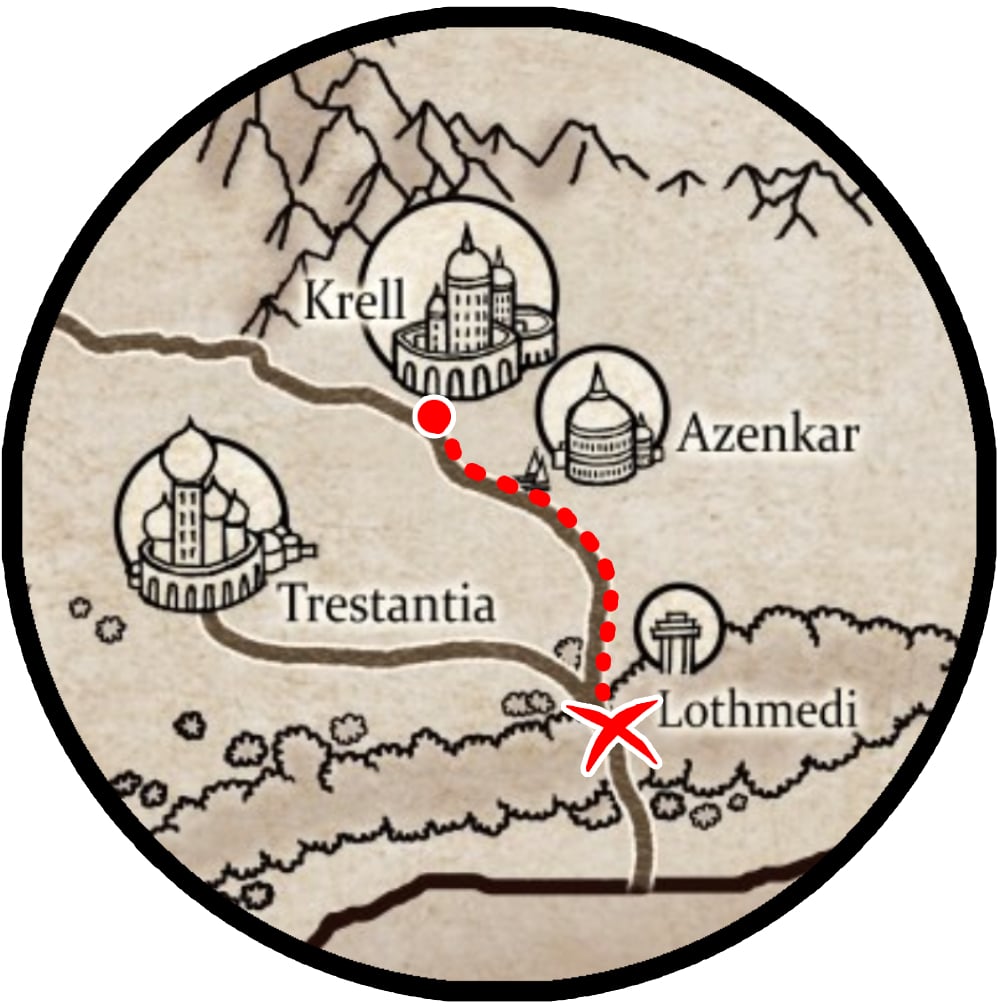
Thanks for reading! I hope you enjoyed this chapter of Seven Forsaken. You can get more serialized content from the world of Altima on my Patreon.
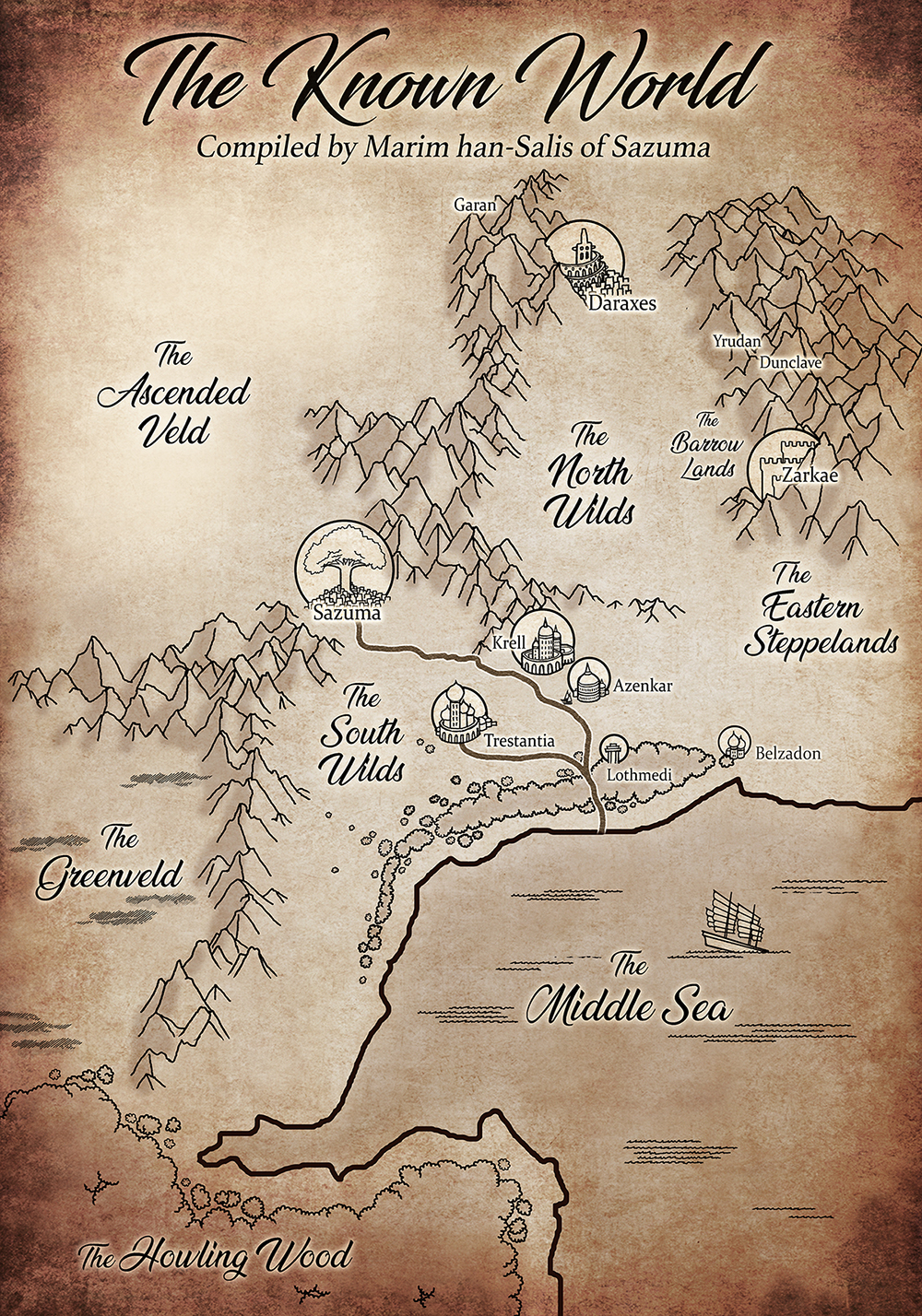
A (Preliminary) Map of Altima
Deities of Altima
THE SEVEN SPIRITS INKARNAM - worshipped by select cults of Azenkar and Trestantia and by some tribes of the South Wilds
- ENDRA - Spirit of Creation
- AER - Spirit of Truth (born of Endra)
- RABA - Spirit of Law (born of Endra)
- THEID - Spirit of Desire (born of Endra)
- OSU - Spirit of the Material (born of Raba)
- ALKEM - Spirit of Change (born of Theid)
- EVER - Spirit of Death (born from a splinter of Endra, broken off in the clash between Raba and Alkem)
GODDESS - the omnipotent creator worshipped in Sazuma and the surrounding areas (thought to share an origin with 'God' of Daraxes and Endra of the faith Inkarnam)
GOD - the omnipotent creator worshipped in Daraxes and the surrounding areas (thought to share an origin with 'Goddess' of Sazuma and Endra of the faith Inkarnam)
OSTIA CASSIDAR - Goddess of Conquest, worshipped in Trestantia (thought to share an origin with Osu of the faith Inkarnam)
OSTIA TORRENS - Goddess of Prosperity, worshipped in Krell (thought to share an origin with Osu of the faith Inkarnam)
OSTIA SAPIAM - Goddess of Knowledge, worshipped in Azenkar (thought to share an origin with Osu of the faith Inkarnam)
You can find my published books on Amazon
Winner of Mark Lawrence's Self-published Fantasy Blog-off 2019
"Fantasy and martial arts aficionados alike should enjoy this emotionally supercharged novel about love and loss, which pierces readers' hearts with the precision of a samurai's razor-sharp blade."
- Blue Ink ★ Starred Review